Take a look behind your toilet, near the floor. See that small valve with an oval or cross-shaped handle? In a lot of homes we visit in Union County, it’s covered in rust, green corrosion or white crust, it won’t turn, or it drips the moment someone touches it. Most people don’t notice until the toilet overflows and they need to shut the water off fast.
That little part is the toilet shut off valve (plumbers also call it a “stop valve,” “angle stop” or, when it comes straight out of the wall, a “straight stop”). Continental Plumbers has worked on bathrooms in Elizabeth, Union and the rest of Union County since 1985, and this valve is one of the parts our customers complain about most. Here’s why it fails, what to do when it’s stuck, and how to make sure it works when you need it.
What the Toilet Shut Off Valve Does
The valve sits on the water pipe that comes out of the wall or floor, and a flexible supply line connects it to the toilet tank. Turn it off, and water stops flowing to that toilet only. The rest of the house keeps running.
That matters because it lets you:
- Stop an overflowing toilet in seconds
- Fix a running toilet or replace a flapper without shutting off the whole house
- Let a plumber replace the toilet or the fill valve quickly
When the valve doesn’t work, every one of those small jobs turns into a bigger one, because the water has to be shut off at the main.
Why Toilet Shut-Off Valves Get Rusty or Stuck
We see the same few causes over and over:
- Nobody ever turns them. Most valves sit in the open position for 20, 30 or 40 years. Minerals from the water build up inside, and the moving parts fuse in place. The first time someone tries to turn it is usually during an emergency.
- Constant moisture. Bathrooms are humid. Condensation drips off the cold toilet tank and the supply line onto the valve, and splashes from mopping reach it too. Over the years, that moisture corrodes the chrome finish and the metal underneath.
- Minerals in the water. Small, slow drips at the stem or the nut leave a white or green crust behind. That buildup makes the valve even harder to turn.
- Old valve designs. Many older homes in our area still have multi-turn valves, the kind with an oval or cross-shaped handle that you twist several times. They close with a rubber washer that dries out and cracks with age. Some are threaded onto old galvanized steel pipe that is rusting from the inside.
- Cheap valves. Some builder-grade valves use thin plating and plastic parts that don’t hold up for long.
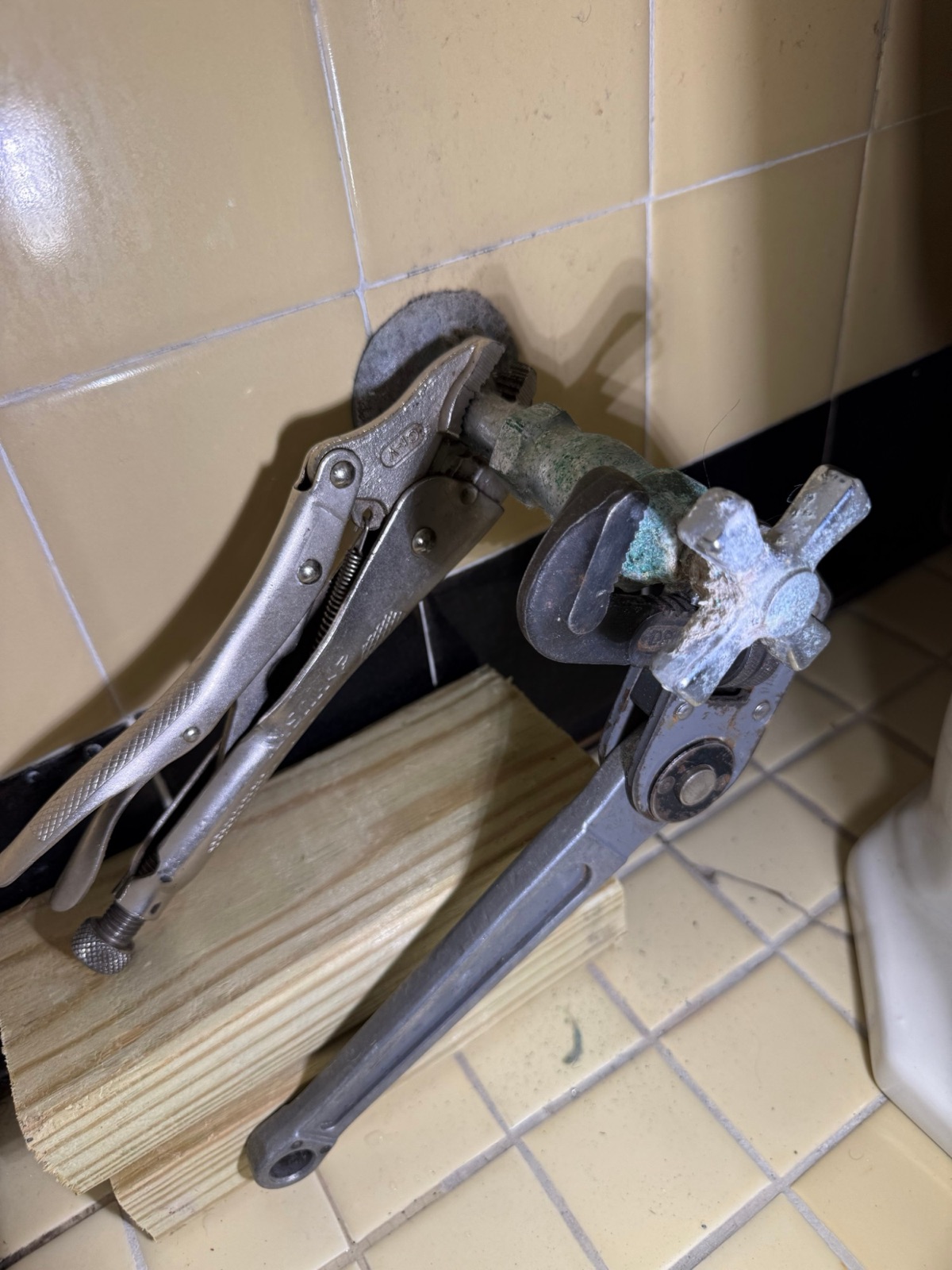
Rust or green crust? Most people call it “rust,” but on an old brass valve the corrosion is usually green or blue-green. That’s the copper in the brass breaking down after years of moisture and slow leaks. Either color means the same thing: the valve is wearing out from the outside, and probably from the inside too.
[PHOTO: toilet-shut-off-valve-corroded-union-county-nj.jpg]
Caption: A real job from our crew: an old toilet shut off valve covered in green corrosion. To remove it safely, our plumber holds the valve body with one tool and turns with another, with a wood block for support, so the old pipe inside the wall doesn’t twist or crack.
Signs Your Toilet Shut Off Valve Needs Attention
- Rust, green stains or white crust on the valve or the nut
- The handle won’t turn, or turns but the water doesn’t stop
- A drip from the stem (where the handle meets the valve body) when you turn it
- Water stains or soft flooring around the base of the valve
- The supply line is an old solid chrome tube or a plastic line that has turned yellow or brittle
Your Valve Won’t Turn? Don’t Force It
This is the most important part of this article. If the valve is stuck, don’t grab a pair of pliers and crank on it. An old, corroded valve can snap, or the stem can break off inside. When that happens, you get water spraying in the bathroom and an emergency instead of a small fix. (You’ll see pliers in our photo above, but that’s with the water shut off at the main and a second tool bracing the valve. It’s a removal, not a homeowner trying to force it closed.)
Instead:
- Try gently by hand. Turn it clockwise to close it. A small back-and-forth motion sometimes loosens it. If it doesn’t move with normal hand pressure, stop.
- Use the main shut-off. If you need the water off right now, close the main water valve for the house (usually in the basement, where the water line comes in near the meter). Everyone in your home should know where it is. Our guide on what to do in a plumbing emergency walks you through it.
- If the toilet is overflowing, lift the tank lid and push the flapper down (or lift the float) to stop more water from entering the bowl while you get to the main.
- Call a plumber to replace the valve, not just to “loosen” it. A valve that was stuck once will usually get stuck again, or start leaking after it’s moved.
The Valve Drips When You Turn It
A small drip from the stem after you turn an old multi-turn valve is common. It comes from the packing nut, the small nut right behind the handle. Tightening that nut about an eighth of a turn with a wrench (while holding the valve body steady with another) will often stop the drip.
If it keeps dripping, or the drip is coming from the pipe connection or the valve body, it’s time to replace the valve. A slow drip behind the toilet can rot the subfloor for months before you see a stain on the ceiling below.
Why We Replace Old Valves with Quarter-Turn Valves
When we replace a toilet shut off valve, we usually install a quarter-turn ball valve. Instead of twisting the handle around several times, you turn it 90 degrees and the water is off. The benefits:
- Fast: you can shut it off in one second during an overflow.
- Easy to see: handle in line with the pipe means open, and across the pipe means closed.
- Fewer parts that wear out: there’s no rubber washer to crack, and a good brass ball valve is less likely to seize.
We also replace the supply line at the same time with a braided stainless steel line. It’s a small part, but old plastic supply lines and lines with cracked nuts are one of the most common causes of bathroom flooding we see.
While we’re there, it makes sense to check the other valves in the house: under the bathroom sink, under the kitchen sink and at the washing machine. They’re usually the same age and in the same condition.
How to Keep Your Shut-Off Valves Working
- Turn them once or twice a year. Close the valve and open it again. This keeps minerals from locking it in place. A good time is when you do your fall plumbing checklist. If a valve already feels stiff, don’t force it. Have it replaced.
- Keep the area dry. Wipe up condensation and puddles behind the toilet. If the tank “sweats” a lot in the summer, mention it to your plumber.
- Look at it when you clean. New rust, crust or a damp spot is an early warning.
- Replace the supply line when you replace the valve, or if it’s more than about 10 years old.
Toilet Shut Off Valve FAQ
Which way do I turn the toilet shut off valve to close it?
For a multi-turn valve with an oval or cross-shaped handle, turn it clockwise (“righty-tighty”) until it stops. For a quarter-turn valve, turn the handle so it sits across the pipe.
Can I replace a toilet shut off valve myself?
It’s possible if you’re handy, but you have to shut off the water to the whole house, and old pipes don’t always cooperate. Corroded threads, galvanized pipe or a soldered valve can turn a 20-minute job into a leak. If the valve is stuck or rusty, it’s safer to have a licensed plumber do it.
Is a little rust on the valve a problem?
A bit of surface discoloration isn’t an emergency, but it shows the valve is aging and has been exposed to moisture. If there’s rust plus crust or dampness, there’s probably a slow leak. Have it checked before it gets worse.
Rusty or Stuck Shut-Off Valve? We Can Help
Continental Plumbers has provided trusted plumbing service in Union County since 1985 (NJ License #9142). We replace toilet shut off valves, sink valves and supply lines, and fix running and leaking toilets in Elizabeth, Union, Hillside, Kenilworth, Roselle Park and nearby towns.
📞 Call (973) 900-0430 or learn more about our bathroom plumbing services.